ddn

David Dellanave

  • Blog
  • Programs
  • Coaching
  • Seminars
  • Contact

by david Leave a Comment

Do you Have to Force Adaptation?

Do you Have to Force Adaptation?

The other day when I was at the airport I did something I haven’t done in quite a while, picked up a Men’s Health magazine for some light airplane reading.

Fitness people love to rag on the big magazines, and some of it is deserved for outrageously incorrect or faddish reporting. But I’d hold MH up as one of the better ones, with consistently great, useful content. If you were to pick up any random Men’s Health and do the workout(s) from it consistently for a month or two, you’d see results.

I happen to know this for a fact because over a decade ago I really got my start by tearing out a 12-week program from MH and doing it with religious dedication and consistency.

Anyway, the gist of one of the articles was that it’s beneficial, maybe even necessary, to force the body to adapt with extreme stressors. Holding your breath under water, extreme hot, extreme cold, etc.

This is a perennial idea in fitness that people talk about all the time, and find new and different ways to implement.

I’m not going to say it’s wrong, but I’d like you to question the premise for a moment.

Is it even possible to force adaptation?

Well to be able to force it would imply that it stops at some point. But does adaptation ever stop?

Was it forced to get the shoulders-rolled-forward, tight hips, rounded back posture of a desk worker?
Was it forced to gain fifty pounds of body fat over a decade?
Did Roger Federer force his right arm (dominant side) to be bigger than his left?

We could come up with countless examples of how adaption isn’t forced, it “just happens.” Adaptation is always happening, whether you want it to or not, and whether you think the changes that are happening are good or bad.

And if it can’t be stopped, then it doesn’t need to be forced.

To speak of forcing adaptation is just a catchy way of saying you’re operating or training at the extreme edge of your limits, which we know extremely well is not physiologically a good way to approach training. Even if you could force it, which you can’t, would it be a good idea?

Have you ever met a powerlifter who just trains at their 1 rep max all the time? Of course not. Strength sport athletes know that their money is in the sub-maximal training.

Think for a moment what it means if you’re always adapting, to everything you do? Doesn’t this apply just as much to the opposite end of the spectrum? To resolving movement issues that have developed after injury, or accumulated over time? Of course it does. You don’t need to force it, you only need to create the stimulus you want and the adaptation will happen.

This is something to think about the next time an article or someone is talking about forcing adaptation. If you can’t stop it, you certainly don’t need to force it.

Filed Under: Blog

by david Leave a Comment

Half Way (Million Pound November Update)

Half Way (Million Pound November Update)

I’ve never been particularly fond of “challenges” because of the mentality with which most people approach them. Too often, people approach a challenge with an outcome in mind. They do a Whole30 because they want to lose 10 pounds. They run a marathon because… they want to lose 10 pounds.

In most cases the structure of an arbitrary challenge isn’t the best way to approach the goal. A carefully considered strategic plan built around your own individual starting point and needs makes more sense.

But what challenges can be really good for are the things you learn in the process when you’re stuck into arbitrary constraints.

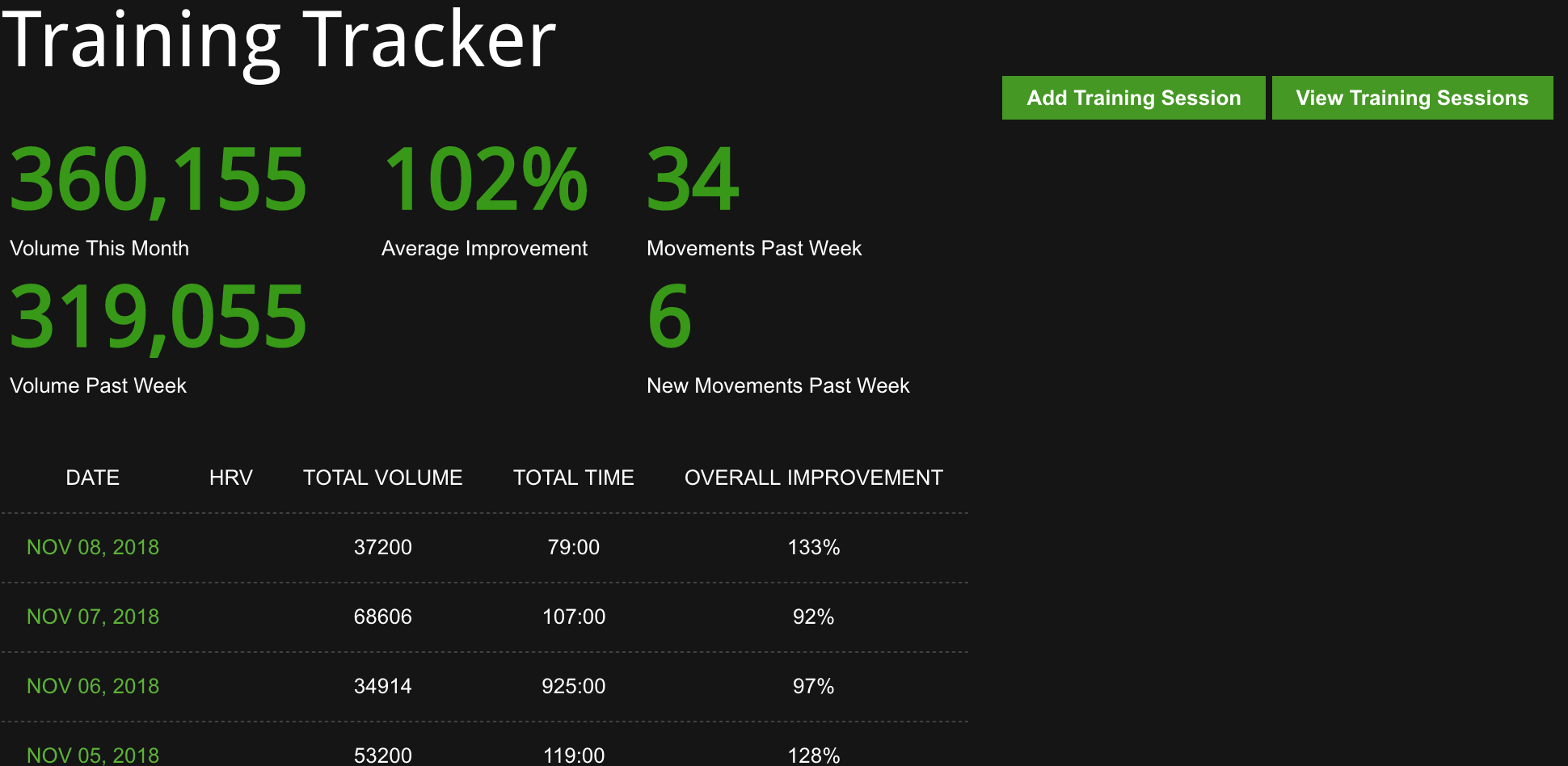
Take the Million Pound November challenge for example. Doing 33,333lbs of volume every single day for a month is at the upper end of most people’s capacity, if it’s within their limits at all. For where I am right now, it’s definitely at my upper end. The last time I completed the challenge it wasn’t, I was training a lot more and a lot harder and I was able to easily knock out 60k and 90k days to create a bit of a natural “wave” in my training – the way physiology actually works.

But now since I’m bumping up against my limits almost every day I’m learning some interesting things. Plus another arbitrary constraint is that I’m going to be traveling the rest of this week, which means I knew I needed to complete 500k by the 12th, so I could take 5 days completely off, and finish the other 500k in the last 13 days of the month.

And I’m smoked.

My hips are exhausted, my lower back is fried, and I’m more than ready for the break.

If not for that arbitrary constraint, I would have already taken a day or two off. But it’s interesting to see how my body is reacting to pushing on even when I know it’s not ideal. I’ve still been testing, and it has continued to test well, but I know that I’m on the edge.

What I’m curious to see is how my body reacts to a full 5 days off after such an intense push. My hunch is that it’ll be enough time to have a pretty substantial recovery, and I’ll come back to find hitting the same kinds of lifting days is way easier than it was over the past two weeks. Only one way to find out, as these things go.

Ultimately, I don’t care what the “outcome” of this challenge is because the reward is in the process and what I learn from it.

How’s your Million Pound November going, or what’s the last challenge you learned something from?

Filed Under: Blog

by david Leave a Comment

How to Track Training Volume

How to Track Training Volume

If you’re newly paying attention to training volume, whether for Million Pound November or simply because it’s an important metric to understand how your training affects your body, you may run in to questions about how to track certain things.

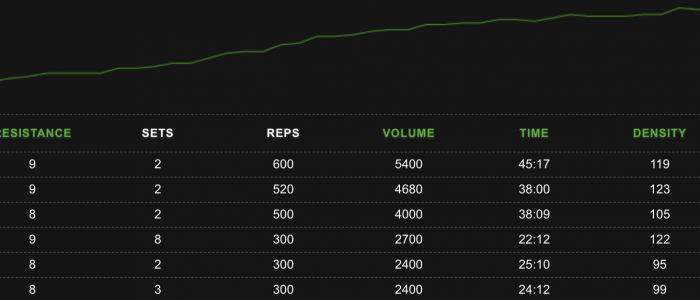
For a bit of background, tracking accurately and diligently is a critical component of the Movement method of training, and I’ve built two tools to facilitate it. One is internal to members of my gym, the other is adaptifier which is available to the public.

As such, we’ve had a lot of time to figure out how to quantify various things that might at first seem hard to track. This applies to keeping score for Million Pound November as it does every day tracking.

  • Bodyweight Movements: Use an appropriate percentage of bodyweight. For example, push-ups are about 70% bodyweight in the hands, adjust accordingly for decline or incline. Bodyweight lunges are about 50% bodyweight, whereas bodyweight squats are about 25% bodyweight. Pull-ups are 100% of bodyweight.
  • Core & Short-ROM Movements: Things like sit-ups or planks aren’t as obvious to track as a bodyweight squat for example. For these I arbitrarily use a value of 25 or 50 depending on how challenging they are. It’s not perfect, but gives you a consistent way to quantify them and that’s more than sufficient.
  • Carries & Non-Stationary Movement: Use the weight you’re carrying as your resistance, and equate about 10 yards or meters of distance as 1 repetition. Multiply accordingly.
  • Weighted Movements: Use the weight on the bar only. I don’t count barbell back squats as a 25% bodyweight squat plus the barbell.

A couple points on tracking in general if you’re NOT trying to keep “score” for the MPN Challenge:

  • Running & Other Cardio: Use your pace on a scale of 1-10 as your resistance, 10 would be as fast as you can go. For reps, multiply your distance in miles or kilometers (just be consistent) by 100. i.e. 1 mile = 100 reps, or 26.2 miles = 2620 reps.
  • Random Other Movement Things: Quantifying things in other forms of training can be really useful, even if they don’t fit into convenient buckets. After a while you’re understand what 3, 5, or 10 thousand pounds of volume “feels” like. You can rate an indoor climbing session on a scale of 1-10 of difficulty, and then track the volume based on that feel of how much work you did. Provided you’re internally consistent,  it’ll be useful over time.

I can’t stress enough how important tracking volume is. Whether your training is going well or poorly you can tell an enormous amount about what is going on simply from this one number. Once you get a handle on how to manipulate volume and how your physiology responds, you’ve unlocked one of the major keys to unbelievable progress.

Filed Under: Blog

  • « Previous Page
  • 1
  • …
  • 4
  • 5
  • 6
  • 7
  • 8
  • …
  • 82
  • Next Page »

Olive Oil

Upcoming Workshops

    No events to show

Search

David Dellanave

David Dellanave, known most often as ddn, is a lifter, coach, and owner of The Movement Minneapolis in the Twin Cities. He implements biofeedback in training; teaching his clients to truly understand what their bodies are telling them. He’s coached a number of athletes who compete at the international level in sports ranging from grip to rugby, and his general population clients readily demonstrate how easy it can be to make progress.

Latest Tweets

  • Just now
  • Follow me on Twitter

Important Pages

  • Coaching
  • Seminars
  • Disclaimer
  • Terms of Service
  • Privacy Policy

Comments

  • david on 3 Tips for Lifting While Sorting Through SI Joint Pain
  • David Brochin on 3 Tips for Lifting While Sorting Through SI Joint Pain
  • Ken on How to Pass the RKC Snatch Test
  • Bethuel Njoroge on Wild Game Hunting: Inhumane or The Most Humane?
  • Jennifer Matthews on 3 Tips for Lifting While Sorting Through SI Joint Pain

Copyright © 2026 · Generate Pro Theme on Genesis Framework · WordPress · Log in