ddn

David Dellanave

  • Blog
  • Programs
  • Coaching
  • Seminars
  • Contact

by david Leave a Comment

Pick Stuff Off The Floor Every Day Challenge

Pick Stuff Off The Floor Every Day Challenge

PSOTFED-Dellanavich

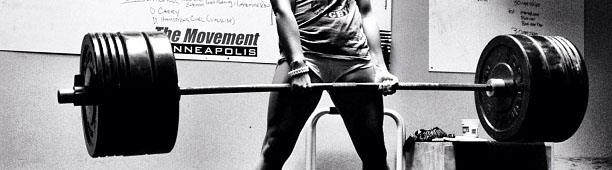
The PSOTFED (Pick Stuff Off The Floor Every Day) challenge originated, to the best of my knowledge, in May of 2012 with Adam T. Glass on his blog. No strangers to lifting frequently, we kicked around the idea of making it a point of focus to pick something from the floor on a daily basis. The rules are simple:

  • Lift an object (any object) from the floor, every day.

That’s it.

How do you define the floor? Does a rack count as the floor? You tell me. Does lifting a kettlebell from the floor once and swinging it count? Only you and your body get to determine what counts. Do you have to do it every single day? Of course not. Do what’s best, but “keep the goal the goal” and seek to meet the challenge.

Why would you do this? What is the benefit?

Picking things up is one the absolutely most fundamental human movements. This is one of the simple ways we interact with the world. It also happens to be one of the pillars of strength and athleticism. As a side benefit, it’s virtually impossible to train lifting things from the floor without netting beneficial training of the grip and hands.

When you’re too worn down or fatigued to train heavy traditional lifts it’s a perfect opportunity to do more grip lifts. Grab a dumbbell by the head and deadlift it, or pinch a couple plates between your thumb and fingers and hold it for time. Challenge your creativity.

As with any challenge, it’s more fun the more people participate. Post what you’re doing on social media with #PSOTFED.

I’m in for Picking Stuff Off The Floor Every Day with @ddn. #psotfed #offthefloor

Click To Tweet

Need some ideas on how to structure your training to deadlift frequently? I got ya covered: “How to Pull of Deadlifting Frequently”

What can you accomplish in 31 days?

Filed Under: Blog

by david 3 Comments

The False Dilemma Problem

The False Dilemma Problem

Paleo and pop tarts. Acupuncture and antibiotics. Hypertrophy and hip openers.

What do these seemingly totally incompatible things all have in common?

They all represent false dilemmas that are presented as binary options that are completely exclusive of one or the other. A false dilemma, or false dichotomy, is a logical fallacy in which only two possible options are offered, often between two extremes, without considering that there may be a third or even many more alternatives.

Positioning and thinking about things in this way is easy and effortless to the point of being outright indolent. It saves the presenter the effort of deeply understanding a topic and adequately conveying nuance and the full spectrum that exists in reality, and it saves the reader or listener from having to expend even a modicum of energy thinking critically about what they’re hearing. This fuels a vicious cycle in which those who use the most absolute language engender bigger audiences and more credibility because of it.

As a matter of fact, humans are so hard-wired to prefer concrete and absolute language that we actually deem a source as to be untrustworthy or lying when they use abstract language.

Which means I’m screwed and you all think I’m a giant liar.

Because the world is far less black and white than many people want you to believe.

Lately, there seems to have been an uptick in the amount of arguing and fighting that happens on social media that boils down to presenting false dichotomies where no such binary choice actually exists.

And we’re all so much worse off for it.

In reality, there is far more common ground between these polar opposites than there is difference in the extremes.

Nutrition_Spectrum

Paleo is juxtaposed against If It Fits Your Macros (IIFYM) and presented as a binary choice between eating pasture raised pork with spinach and donuts, protein shakes, and peanut butter. The reality is that there is far more common ground between Paleo and IIFYM than any trite Facebook nutrition meme poster would ever prefer to admit. Presented with any fit, healthy, reasonable Paleo or IIFYM afficionado what you’ll find is that the vast majority of their diet ends up looking exactly the same. They will eat large amounts of vegetables, protein from whole food sources such as fish and meat, and carbohydrates from plant sources. From my experience attending everything from Paleo f(x) to the Arnold, I can tell you that people from both ends of that spectrum eat donuts, ice cream, and candy and people from both ends of the spectrum eat grass-fed farmer’s market beef.

Medicine_Spectrum

Alternative medicine has been a favorite target of the evidence-based science-über-alles crowd in recent years, but they’ve failed to acknowledge that in between the false choice of alternative and Western medicine there is a vast gulf of agreement about what constitutes good medicine and what promotes good health. Are there alternative medicine practices and practitioners that are utter scams? Absolutely. Are there Western medicine doctors who are downright criminal in their actions? Yes. But in between you have a wide variety of practices of dubious scientific efficacy when studied in isolation that just happen to work in a clinical setting to deliver the intended results for patients and clients. At the end of the day, virtually every clinician no matter what end of the spectrum they’d place themselves on would agree that the majority of maintaining health involves eating well, sleeping adequately, and exercising just enough.

Exercise_Spectrum

When it comes to training, there are only two modes, right? Either you’re doing corrective exercises for hours on end, or you’re hardcore smashing weights and crushing personal records, right? That’s certainly how it would seem when you spend any amount of time reading training articles online. You’re either doing everything right in spending all your time trying to “fix” movement problems with corrective exercises, or you’re completely wrong to waste any time on it because you should just be putting more weight on the bar and getting out of your own way. Let’s not even get into the spectrum of exercises that are deemed to range from worthless to Holy Grail. And YET, we often fail to acknowledge that the vast majority of both corrective and performance oriented training lies in the wide band between exclusively corrective and probably-closer-to-destructive-than-corrective. In fact, I’d argue that all exercise is actually BOTH corrective and performance-enhancing – provided it tests well (via biofeedback.)

This Nonsense Is Killing Us

If we can agree that as a collective all the people who care about their health, wellness, fitness, strongness, etc. make up a community (there’s that setting aside the differences of extremes idea again) then we owe it to the rest of the community to recognize that very little of anything is actually more than a couple standard deviations away from the exact same thing everyone else is doing, and there’s no point in arguing about which is the correct answer.

In doing so we add confusion and doubt over the parts that really matter, and add nothing of value by focusing on the one percent of one percent that is different and acting like it’s a matter of kind, not degrees. When people are confused about things that are already intimidating and scary you know what they do? Nothing. We don’t need more people doing nothing, what we need, as a community, is more people doing the stuff that matters — the stuff that we ALL actually agree on when it really comes down to it.

Filed Under: Blog

by david Leave a Comment

Biofeedback Question: Am I Just Warming Up?

Biofeedback Question: Am I Just Warming Up?

A question that comes up fairly often with people who are new to using biofeedback in their training is about whether or not they are simply warming up as they do movements and things test better and better.

Here’s the short answer: no, you’re not just warming up.

But let’s get into the longer answer, just for fun.

First thing’s first, I am going to assume that the testing results someone is getting are accurate, and not hampered by pushing to end range of motion, or ignoring the first signs of tension. See here for some common fixes. 

But what if everything really does test better and better?

The first thing to understand is that warming-up is not happening in the mechanistic sense that we often attribute to it by the words we use. There is no actual change in temperature of joint synovial fluids and any muscular temperature increase is debatable. The effects and benefits of warm-ups are hotly contested, and some studies have shown that injury risks actually increased with the use of a warm-up.

So what IS going on with a warm-up, and why do we do it? Why does it seem like we can move more freely when we do a warm-up? And an important question, why doesn’t it always work?

Warm-ups tend to have an effect that allows you to move more freely most of the time because movement that tests well allows for more movement! That is the entire basis of biofeedback testing. You quantify a movement (the toe touch), you do another movement, and then you quantify the movement again to see if it has increased. Theoretically you could do the same thing with your deadlift 1-rep max as the test, but the error introduced by the testing itself would be prohibitive. Using a brief max effort squeeze of a grip dynanometer is similar, at a lower error and cost of testing.

Range of motion is mediated by the brain, as an output that is generated after all of the various inputs from sesory receptors such as Golgi tendon organ and nociceptors as well as the brain’s own map of the body in space.

So when you do movement that tests well, you very likely ARE getting more range of motion. But if you think that all movement is going to “test well” and allow for more and more, think again. This is best illustrated with one of my favorite stories, as it’s so applicable.

A new client I was working with mentioned that whenever he went out for a run his first interval would be abysmal, but after taking a short walking break, all subsequent intervals felt great up until the end of the workout.

I asked what he was doing for a warm-up, and he told me that he was using a dynamic warm-up for runners that he got out of a running magazine.

So I suggested an experiment. Next time he went out for a run, instead of his usual warm-up, he was to do 3 sets of 10 bodyweight reps of the three exercises that regularly tested best for him in the gym.

Can you predict the outcome of this little experiment?

Sure enough, his first interval felt just as good as the rest of them. As it turns out, his regular warm-up did not test well for him at all, so subsequent movement suffered. The running itself seems to have tested well, so it was only after he took a short break that things reset and he was able to benefit from that movement. Switching to a warm-up of things that tested well allowed what followed to be performed at higher function.

It’s Only a Matter of Time

If you use biofeedback long enough, you are guaranteed to have the seminal moment in which you test an exercise and your range of motion is suddenly and significantly reduced. This may take a few sessions, a few months, or more than a year depending on what you do and how you move. But it WILL happen when you find something that significantly conflicts with what is best for your body.

Until then – keep testing.


Filed Under: Blog

  • « Previous Page
  • 1
  • …
  • 50
  • 51
  • 52
  • 53
  • 54
  • …
  • 82
  • Next Page »

Olive Oil

Upcoming Workshops

    No events to show

Search

David Dellanave

David Dellanave, known most often as ddn, is a lifter, coach, and owner of The Movement Minneapolis in the Twin Cities. He implements biofeedback in training; teaching his clients to truly understand what their bodies are telling them. He’s coached a number of athletes who compete at the international level in sports ranging from grip to rugby, and his general population clients readily demonstrate how easy it can be to make progress.

Latest Tweets

  • Just now
  • Follow me on Twitter

Important Pages

  • Coaching
  • Seminars
  • Disclaimer
  • Terms of Service
  • Privacy Policy

Comments

  • david on 3 Tips for Lifting While Sorting Through SI Joint Pain
  • David Brochin on 3 Tips for Lifting While Sorting Through SI Joint Pain
  • Ken on How to Pass the RKC Snatch Test
  • Bethuel Njoroge on Wild Game Hunting: Inhumane or The Most Humane?
  • Jennifer Matthews on 3 Tips for Lifting While Sorting Through SI Joint Pain

Copyright © 2026 · Generate Pro Theme on Genesis Framework · WordPress · Log in