
ddn

David Dellanave

  • Blog
  • Programs
  • Coaching
  • Seminars
  • Contact

by david 3 Comments

5 Fixes For A Common Biofeedback Testing Question

5 Fixes For A Common Biofeedback Testing Question

By now I’d estimate I’ve personally taught about a thousand people how to use range of motion as a biofeedback test. I find it incredibly effective, and I think it’s a proximal association to why my clients get better results than when doing whatever they did before (or sometimes after) training with me.

With that many reps, I’ve seen a few patterns or issues that people run into. In Jen’s new coaching group for Get Stronger Faster a question came up that I think can be instructive for a wider audience, since I see it in about 10% of the people I teach testing to. Basically the question goes:

I never see a difference in the testing. My range of motion always stays the same. What am I doing wrong?

Here are five things you should be aware of that will probably help:

1) If you’re not already, make sure to touch on your body (shins, ankles, feet) so that you can get a good measurement of the actual range of motion. It can be hard to tell if you just have your hands hanging out in front of you._D3C2481 Testing 4

2) People’s sensitivity varies. Some people have a very wide range from bad to great, and some people will never see more than an inch total variation. It’s highly individual. If you’re one of the people for whom the range is much smaller you’ll have to pay much closer attention.

3) Some people treat the test as a stretch and push too hard. It’s critical to stop at the FIRST sign of tension anywhere in your body. What this means is that if you’re stretching to the very end of your range of motion, you might be blowing past that first sign of tension. For me personally I note tension with my fingertips right at my ankles, but even then I can push my knuckles all the way to the floor if I force it. Notably, I can ONLY put my palms flat on the floor when I have done something that tests very well.

4) When you very first start testing, it can be good to compare two different tests to make sure that they agree. We call this “testing the test”. You can use the toe touch as well as a side or front arm raise to compare. They should both agree on the increase or decrease, which verifies that it’s a valid test for you. The side arm raise is exactly what it sounds like, just raising your arm out to the side and noting the angle. Very few people can put their arm straight out above their head with no tension. Same with the front raise.

5) Finally, it’s worth nothing that some people WILL test well for nearly everything. This is a good thing! My only clients who test well for a very narrow range of movements, and test out of it quickly are the ones dealing with severe chronic pain, and or rehab situations. You don’t want to be there! That being said, every single client I have ever worked with, even those from whom everything seems to test well, eventually has their watershed moment where something tests badly and they can clearly see the correlation of why that movement wasn’t good that day.

I hope these things to check are helpful. Drop a comment if this is useful or if I can clarify any more on this specific topic.

Filed Under: Blog

by david Leave a Comment

Why did you do that? To see what would happen.

Why did you do that? To see what would happen.

It’s very likely that some of my clients think I’m a real pain in the ass to work with. I have to be, at least from their initial perspective, for it’s exactly what makes me seem like I’m being evasive is exactly what gets them the unprecedented results they’ve been looking for.

Here’s a typical conversation: “Hey David, I have a question for you.” To which I respond, “OK, I have questions for you.”

I don’t have (many) answers, but I have a lot of questions. To understand what that means, we have to take a trip back to middle school science.

The Scientific Method

If you’re not familiar with the scientific method, you’re about to get a crash course. The scientific method is currently the best algorithm we as monkeys who stood up have to begin to understand the world around us. It’s far from perfect, but it’s what we’ve got.

The scientific method begins with asking a question.

“If the sun is so powerful but the power is very widely distributed, what could I do to harness the power of the sun?”

or:

“How do I make muscles bigger?”

The next step, perhaps preceded by some amount of research, is to construct a specific hypothesis that can be tested. The hypothesis is an educated guess as to what happens or how it happens. The key to a good hypothesis is that you have some idea in mind, and that it can be tested specifically.

“If I were to use a magnifying glass to focus the power of the sun on one spot it might be powerful enough to create fire.”

Or:

“If I were to do bicep curls often, my bicep muscles would get bigger.”

Notice that the scientific method begins with a question, but a hypothesis is more like a statement of belief.

Next, you would design an experiment to test the hypothesis. Experimental design is important because the results are only as good as the experimental design. You can be perfectly correct in your hypothesis, but not prove it out correctly because your experimental design was flawed.science

“I will take a magnifying glass that combines a 6 inch diameter area of sunlight into a spot one sixteenth of an inch in diameter and determine how much heat is generated by measuring the temperature rise on the bulb of a thermometer. Or just burn some ants.”

Or:

“I will do one set of bicep curls to failure every other day for the next 4 weeks.”

Keep in mind the limitations of experiment design. For example, I rarely if ever train to failure, but if I were designing an experiment for multiple people I would want to control the variables, so I might use failure as a common stopping point for everyone.

Once you’ve come up with your experiment that you’re going to use to test, you’ll perform the experiment and collect data.

Collecting data on your experiment is vital. I am one of the biggest proponents of keeping a training journal or log. This is your experiment data.  You are hopelessly lost without it. If your training results suck I would bet my stack that you don’t keep a training journal.

Second to last you analyze your data. In short, did it work?

“Through a highly accurate analysis of the smoke coming up from the melting ants, I was able to determine that a magnifying glass does in fact enable you to concentrate the power of the sun.”

Or:

“My biceps have grown a half-inch in circumference since 4 weeks ago, proving that 4 weeks of 1 set of bicep curls to failure appears to be associated to muscle growth in my biceps.”

Finally, and this is perhaps the most important step of all: construct a new hypothesis or ask a new question. The fundamental limitation of the scientific method is that when you’re done with an experiment you have an answer that is very limited in scope, most especially temporally or in terms of time. In other words, you only know that what happened, happened right now – you don’t know that it will always happen and you don’t know that it will happen to everyone unless you test everyone. One set to failure of bicep curls might make your muscles grow now, but unless it always makes (your) muscles grow then it’s not really the answer, it’s an answer.

The question you ask could be bigger, such as could the same principle apply to other muscle groups? Or it could be smaller, such as what would happen if you were to change the movement variation slightly.

In any case, the process never ends.

The Experimental Mindset

This questioning or experimental mindset is one of the most fundamental ideas I hope to instill in people I interact with. No one else has the answers, but they’re inside of you if you are willing to ask the questions to find them.

Success-Mindset

Asking better questions, like nearly everything worth doing, is a skill that you will develop over time. As a coach I consider asking questions to be my most valuable skill. When I ask a client if turning their foot out slightly makes their movement feel better or test better I am asking a better question of their body. Sometimes the questions are the more traditional kind such as “how much protein are you eating” but often the questions are for the body, such as “what happens if you eat more protein?”

One of the unexpected benefits of approaching training (and life) with this experimental mindset is the understanding that experiments often don’t yield the results you predict or expect, and that’s an acceptable natural part of the process. Too many people are wrapped up in guilt with what they can and can’t do or change especially when it comes to exercise and health. If you decide that you’re going to start eating better across the board it’s easy to feel guilty and frustrated when you predictably fail a few days in. On the other hand, if you acknowledge that it’s an experiment to see what you’re capable of doing then it’s simply a data point when you realize that you aren’t capable of doing what you had in mind – yet.

Filed Under: Blog

by david Leave a Comment

What do I do for cardio?

What do I do for cardio?

Ah, cardio! In other words, anything over five reps. My favorite forms of cardio include deadlifting for between 20 and 50 reps per set, one-arm rowing heavy dumbbells for 20+ reps, and loading atlas stones to a platform or my shoulder for as many reps as possible.

If that doesn’t sound like anything remotely resembling something you’ve considered cardio before allow me to explain. In short, we’ve learned that the commonly held belief that there is a dichotomy between resistance training and cardio is completely false. In reality, these systems overlap and in the gaps between intense exertion you have, essentially, “cardio.” Or what my wife, Jen Sinkler, has been credited has having coined “Lifting weights faster.”

After my email yesterday about the amount of distress I was under during the Lift Weights Fasterlaunch a few people emailed me and asked how I can reconcile the idea of doing circuit workouts with set time or rep frames and the idea that you should be doing exactly what is best for your body. It’s a great question and I’m glad that some people reached out so that I can expand on it for everyone.

The type of strength training I advocate is primarily eustressful. If you’re not familiar with the term it is colloquially considered “good stress” but we use a more useful definition: stress that is easily resolvable. On the other hand, distress is stress that is not easily resolved. Another way to say that is that distress has a high cost, whereas eustress has a low cost.

While I absolutely hold that you should be optimizing for the maximal effective amount of eustress training, a minimal effective amount of distress training is also important.

The reason why is a matter of adaptability and specificity. Specifically, if you never ever train in distress you will not be able to handle any amount of distress. However, if you train a minimal amount relative to your needs, you’ll be better equipped to handle a distressful situation. The more distress you are likely to encounter in sport or life, the higher your minimal effective amount is.

Throwing in an untested, potentially distressful circuit at the end of a workout on occasion provides you an opportunity to train for the position you might find yourself in. Sometimes you just don’t have a choice and you need to gut it out, whatever it is. Training that ability is exactly what you’re doing when you grit your teeth and keep going in a tough conditioning workout.

I don’t usually particularly enjoy conditioning workouts, but I recognize the necessary role they fill.

A primarily eustressful training model combined with a minimal effective amount of distress training is a recipe for unparalleled success.

Which is why it’s the exact model we use at my gym, The Movement Minneapolis. In fact, for the past 6 months my members have unwittingly been the guinea pigs for over a hundred of Jen’s Lift Weights Faster workouts. Doing so gave us an unparalleled sample size to tweak and tune the workouts so that they’re just right.

I can’t say enough good things about the library Jen has put together. It’s absolutely massive, and comprehensive:

jpeg-3

Whether you love that a quick circuit workout can provide a great stand-in for a more traditional strength workout, don’t have the facilities or equipment for more involved workouts, or like me, simply recognize the necessity for a little heart-pumping lung-burning action you will love Lift Weights Faster.

And if you’re stuck, frustrated with a lack of progress and need a complete overhaul of your training you might want to pick up Get Stronger Faster while the opportunity lasts. During the launch special it is being offered as a $29 add-on to Lift Weights Faster which is something I only did as a favor to my lovely wife! Afterwards, I will be offering it alone at a higher price.

Today is the last day of the 50% off launch sale, so grab it while it’s on sale.

Taken together, these two programs are as close as you could get to training at my gym without setting foot on Minnesota’s frozen soil. Call me biased, but the results I get for my clients who range from people lifting their first dumbbell to athletes at the highest levels of their sport speak volumes about the efficacy of what we’re doing. It’s certainly unconventional, but perhaps that’s exactly why it works.

Filed Under: Blog

  • « Previous Page
  • 1
  • …
  • 64
  • 65
  • 66
  • 67
  • 68
  • …
  • 82
  • Next Page »

Olive Oil

Upcoming Workshops

    No events to show

Search

David Dellanave

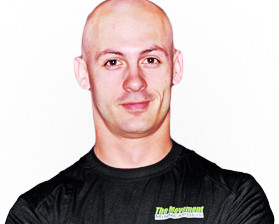
David Dellanave, known most often as ddn, is a lifter, coach, and owner of The Movement Minneapolis in the Twin Cities. He implements biofeedback in training; teaching his clients to truly understand what their bodies are telling them. He’s coached a number of athletes who compete at the international level in sports ranging from grip to rugby, and his general population clients readily demonstrate how easy it can be to make progress.

Latest Tweets

  • Just now
  • Follow me on Twitter

Important Pages

  • Coaching
  • Seminars
  • Disclaimer
  • Terms of Service
  • Privacy Policy

Comments

  • david on 3 Tips for Lifting While Sorting Through SI Joint Pain
  • David Brochin on 3 Tips for Lifting While Sorting Through SI Joint Pain
  • Ken on How to Pass the RKC Snatch Test
  • Bethuel Njoroge on Wild Game Hunting: Inhumane or The Most Humane?
  • Jennifer Matthews on 3 Tips for Lifting While Sorting Through SI Joint Pain

Copyright © 2026 · Generate Pro Theme on Genesis Framework · WordPress · Log in