ddn

David Dellanave

  • Blog
  • Programs
  • Coaching
  • Seminars
  • Contact

by david 3 Comments

Using Biofeedback in Competition

Using Biofeedback in Competition

Using biofeedback in training has distinct, proven advantages over other methods of training that do not incorporate auto-regulation, or adapting the stimulus to the state of the system. Biofeedback essentially allows you to get more out of your training at a lower cost in terms of stress and recovery. The long-term benefits of this should be obvious in reducing injuries and maximizing progress. Training is often like the fable of the tortoise and the hare. Slow and steady gains beat short intense bursts of progress followed by long recovery from injury.

But, it’s not as obvious how biofeedback can be used in the competition context to win.

There are two main ways to use it that I have used myself and in athletes I coach.

1. Selecting Movement Variations

Even in the sport of powerlifting, which has a fairly limited range of options for how you can legally perform a lift, there are still quite a few options. You can squat high-bar or low-bar, wide stance or narrow, ass to grass or just below parallel and so on. In the bench press you can vary your grip, foot placement, and bar path among other things. In the deadlift you’ve got two main stances to choose from, everything in between, as well as smaller variations like round-back or not.

All of these things can be tested.

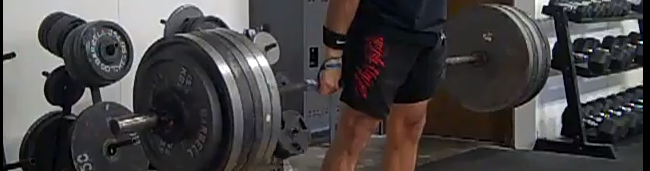
In her most recent meet my wife, Jen Sinkler, made a last-minute switch to a conventional stance from a poorly-testing sumo stance. The result? A roughly 60-pound PR in her conventional stance that she hadn’t been training in years, a 2.5kg lifetime competition PR in the deadlift, a Minnesota state record, and a meet win. Oh, and a 364 pound deadlift.

Results may not always be this dramatic, but when faced with a choice you may be given an opportunity to select the best-testing movement for your body that day. Doing so, in my experience, is virtually guaranteed to result in the best possible result with the least chance of injury when you’re inherently testing the absolute limits of your body.

2. Potentiating Other Movements

Movement that tests well has a striking effect: It potentiates, or increases the output of, all other movement. To put that another way, you could take the output or quality of any given movement as your metric, do a movement that tests well, and then do the first movement again and it will be better. That’s just how it works. In fact, that’s the principle that the ROM or grip testing is based on: if you do something that tests well, you will get more from the ROM or grip.

How can you use this?

In between competitive events that may or may not test well – that part is irrelevant – you can do movements that you know test well. This can be informed from your previous training and knowing what works for your body, or it can be from movements that are components or opposites of the movement you’re competing in. Two examples:

  • In grip competitions when every last tenth of a kilogram matters I would often do movements that test well for me, rows and deadlifts (no load, just the movement) primarily, in between the grip events.  In some contests this has been the difference between making the next weight jump and not making it at all.
  • This last meet that Jen competed in her back was pretty tight after the bench press. She doesn’t have great extension, and the extreme arch in the bench probably didn’t test well for her. Before the deadlift, a lift where extension is required, I had her doing some one-hand reverse extensions which test exceptionally well for her. It’s impossible to quantify how much this helped in such a big lift, but it instantly made her back feel closer to normal.

In short, a quick and easy “hack” to increase your movement quality in ALL the movements you do is to do a few reps of something that tests well. You can almost think of it as a sub-micro training session that makes you instantaneously better – the same idea we’re going for in training over the long term.

Preparation Meets Opportunity

A few movements that test well aren’t going to make up for a lack of training, a lack of preparedness, or a lack of capability. It’s not magic. But when you bring a complete package of training and preparedness to the competition, biofeedback can still help you on game day to put it all together and maximize your potential.

Filed Under: Blog

by david Leave a Comment

Biofeedback For The Literal Win

Biofeedback For The Literal Win

Read how to use Biofeedback in Competition

It was the middle of last week and I was worried. I just happened to be walking by the door to the training floor at The Movement Minneapolis at the exact moment that my wife, Jen Sinkler, took a pull on a heavily loaded bar, barely broke it off the ground, and then knelt on the ground behind it. I did a double take, took two steps back into the doorway, and said: “What was that?”

“Oh, ahh, nothing, totally fine,” came her response.

It did not look fine to me.

One thing I know about Jen is that she doesn’t show, or even admit, for that matter, weakness when it comes to competition – and the powerlifting contest she had been training for was a mere five days away. I asked about it later and was met with more insistence that everything was fine and that her “hip flexors were just tight.”

I didn’t give it any more thought until six of nine lifts were in the books and Jen was going into the deadlift with a 2.5-kilogram lead against her arch rival. It’s also worth mentioning that because of a rule change in weight classes, any records broken at this meet would have their holder’s names in the Minnesota state record books forever. She already held the squat record and she was going for the deadlift and total record.

But her hips were in pain. She pulled a little over 138 kg (305 pounds) in her normal competition sumo stance in the warm-up area and it was suspiciously slow and effortful.

To even maintain her lead, she was going to have to deadlift something equal to or greater than her previous meet lifetime PR of 162.5 kg (358.2 pounds), and her rival was opening 7.5 kg (roughly 16 pounds) higher than she was. She needed big pulls, and she wasn’t looking to be in any kind of shape to pull big.

“It’s really hurting my hip flexors at the bottom of the pull now,” she said.

On a hunch, I asked, “How does conventional test?”

Even the best of us forget the basics sometimes, and Jen hadn’t considered questioning her premise that sumo was her best competition stance. She took a few seconds to run through the testing protocol and discovered that sumo tested terribly, while conventional tested extremely well. She went back to the 138 kg bar, pulled it conventional, and tested. Not only did the weight fly up, but it tested extremely well.

Jen walked out onto the platform and confidently pulled 147.5 kg (325 pounds), then 160 kg (353 pounds), and then 165 kg (364 pounds) to seal a lifetime deadlift PR, the state deadlift record, the total record, the middleweight win, and the meet’s best lifter award. Her rival pulled 162.5 kg (358 pounds), a pull that would have likely given her the win, resulting in her name in the record book, had Jen not switched her style of deadlifting that day.

IMG_2697

Up to that point there were many factors to thank for getting her there. Chad Wesley Smith’s Juggernaut programming, which had a squat emphasis, put 15 kg on her total. Advice from some other badass female lifters helped her cut a few pounds and make her weight class. Her lifting partners provided encouragement and support to keep her training consistent.

But none of that would have mattered had she not tested her movement before stepping out on the platform. She had been doing too much of the same thing, she was in pain, and there is no way she would have pulled a lifetime PR deadlift in that condition. She may have even injured herself.

Biofeedback for the win, indeed.

You know, it’s funny, every once in a while some jackass, thinking they’re finding a flaw in the system, will ask me, “Well, what if something doesn’t test well on meet day, do you just tell them you can’t lift that day?” And the answer is, no, you step out on the platform and you do what you have to do no matter what – because it’s competition. But, if you can adjust your game and make better decisions because of biofeedback, then you’re not at a disadvantage: instead, you’re gaining a massive competitive advantage.

This isn’t the first time I’ve seen this play out, but it is certainly one of the most dramatic.

And, it came as a wonderful punctuation to last week’s Off The Floor anniversary sale that ended this weekend. (I extended it for a couple days because of Jen’s victory.)

Ultimately, if you’ve been on the fence about biofeedback testing, I want you to ask yourself if you’re going to question your premises or stay where you are.

If you already have been testing and following your body, then I have a challenge for you: what things are you not questioning that could get you better results?

The quality of your answers depends on the quality of your questions.

P.S. Thank you to everyone who picked up OTF last week. Your support means the world to me, and allows me to continue doing what I love and providing great information.

Filed Under: Blog

by david 3 Comments

Better Biofeedback Pull-up Program

Better Biofeedback Pull-up Program

Liz_Pull-up

Ask almost any coach who has been around for a while how to do more pull-ups and they’ll likely mention Pavel’s Fighter Pull-Up program. And for good reason, because it’s a great program that hinges on a fundamental tenet of many good training programs: high-frequency of training at sub-maximal intensities.

For those unfamiliar with the program the idea is to take your best max pull-up set, do a maximal set, and then do about 4 drop-off sets of fewer reps each. You may only do 3 drop-off sets just dropping a rep each set, or you may do up to 5 more sets dropping 5 reps per set all depending on what your total rep max is. Someone who can do 25 reps is going to need more of a drop-off than someone who can do 5.

But, it could be better.

The problem with the Fighter Pull-up program is that it’s essential a linear progression distress training program. Another way to say that is that you have to hit a certain number of reps and you’re expected to always be increasing that number and if you don’t the whole thing falls apart. The instructions for what to do if you don’t hit the prescribed reps is literally: “If you run into a snag with this routine, back off a week and build up again. If you hit the wall again switch to another routine.” So if it doesn’t work, do something else. Duh.

I’d like to present to you the Better Biofeedback Pull-up Program. This program is both a great introduction to biofeedback training keeping it simple and to just one exercise, as well a more advanced and smarter way to approach pull-up training. I’ve used this exact method with countless clients, and myself, to increase my pull-up strength and ability.
Pull-up-button


P.S. If you want a full biofeedback-based training program you need to check out my deadlifting program, Off The Floor.

Filed Under: Blog

  • « Previous Page
  • 1
  • …
  • 56
  • 57
  • 58
  • 59
  • 60
  • …
  • 82
  • Next Page »

Olive Oil

Upcoming Workshops

    No events to show

Search

David Dellanave

David Dellanave, known most often as ddn, is a lifter, coach, and owner of The Movement Minneapolis in the Twin Cities. He implements biofeedback in training; teaching his clients to truly understand what their bodies are telling them. He’s coached a number of athletes who compete at the international level in sports ranging from grip to rugby, and his general population clients readily demonstrate how easy it can be to make progress.

Latest Tweets

  • Just now
  • Follow me on Twitter

Important Pages

  • Coaching
  • Seminars
  • Disclaimer
  • Terms of Service
  • Privacy Policy

Comments

  • david on 3 Tips for Lifting While Sorting Through SI Joint Pain
  • David Brochin on 3 Tips for Lifting While Sorting Through SI Joint Pain
  • Ken on How to Pass the RKC Snatch Test
  • Bethuel Njoroge on Wild Game Hunting: Inhumane or The Most Humane?
  • Jennifer Matthews on 3 Tips for Lifting While Sorting Through SI Joint Pain

Copyright © 2026 · Generate Pro Theme on Genesis Framework · WordPress · Log in