
ddn

David Dellanave

  • Blog
  • Programs
  • Coaching
  • Seminars
  • Contact

by david 1 Comment

Get Obsessed With Consistency

Get Obsessed With Consistency

“Get obsessed with consistency.” The words hit me like the fastball that got me one of many rounds of stitches, right at the eyebrow.

I was reading a pre-release copy of my friend JC Deen’s Stay Leaner Longer, and while that is a fantastic book that I also think you should check out, that’s not entirely the point of this email.

The quote was from a perhaps well-known in small circles Dubai trained named Amir Siddiqui. Amir is known among other coaches for his irreverent take on training, but also his formidable physique and the results he gets with his fancy-pants Emirati clients.

Amir looks like what Batman would look like if he grew a beard and packed on forty pounds of muscle. This is a guy who walks the walk and doesn’t have to convince you because you can see it.

Amir-Consistency

This quote, this quote about consistency has been ringing in my ears for a couple months now since I read it. The problem, as I see it, is that people get obsessed with goals. Women imagine what it will look and feel like when they lose thirty pounds and they fit into their skinny jeans. Guys think about what they’re going to look like when they hit that 500 pound deadlift. Some literature on goals will even recommend this strategy and really encourage you to visualize down to the last detail what it will be like when you hit that goal.

And then reality sets in and you realize that the goal is months, if not years, away and you wonder if this one workout even really matters. If it makes any difference at all if you just go home and hit the couch tonight. You can always catch up tomorrow.

Except that it does matter, and you can’t catch up. Even if you could, realistically you won’t.

The consistency is what matters. Get obsessed with it. Be more obsessed with making it to your next training session than the end goal you have in mind. Be more obsessed with getting the most out of the training session that you’re in the midst of than how you’re going to feel when you achieve the goal.

When it comes to physical transformation, consistency trumps perfection every single time. In school I learned the hard way what it meant to my overall grade when I got a 0 on an assignment I didn’t do. My grade tanked. Even if I had turned in something half-assed and gotten 50%, I still would have had a better average final grade. At Juggernaut’s Become Unstoppable 3 some folks were talking to Mike Israetel and expressing some awe at just how god damn big he was. He said, “Look guys, there’s no secret. I never miss a training session, and I never miss meals.” I thought back to the previous day when everyone else was sitting around chatting and Mike was lifting. I don’t think he has missed a lift or a protein shake in a decade.

It’s not hopes and dreams that add up to big goals, it’s action.

Filed Under: Blog

by david Leave a Comment

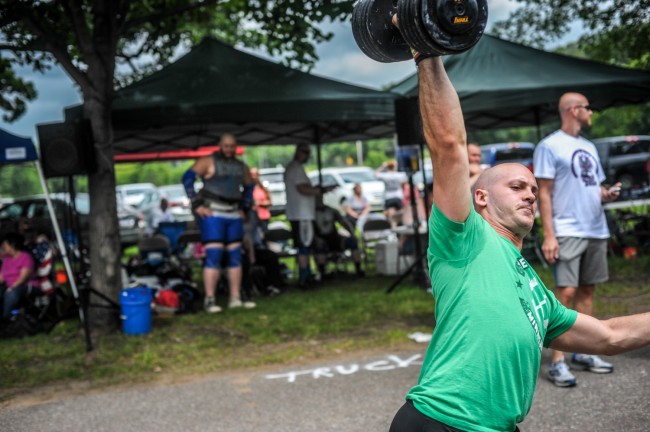
Physically Cultured Challenge: 500 Push Presses

This challenge, something as close to cardio as I get except for the occasional Lift Weights Faster workout, is one of my favorite feats I’ve ever worked on. It’s deceptively simple which may have you looking at it and thinking “that’s it?” I probably had the same reaction when Adam T. Glass issued the challenge to me because I know it took several months to achieve it.

So, let’s see you give it a shot.

The challenge is 500 16kg (35lbs) push presses in 15 minutes for men, 12kg for women.

I personally prefer a kettlebell for this challenge, but you can do what you feel.

You may switch hands as often as you like, and you can rest or do whatever you want but I assure you there is little time for anything but push pressing.

Filed Under: Blog

by david Leave a Comment

Biofeedback By Any Other Name Would Be as Awesome

Biofeedback By Any Other Name Would Be as Awesome

I don’t have a smart and allegorical or snarky and funny introduction for this piece, and I’m certainly not going to win a Pulitzer prize for it, but this topic has come up enough times to address it.

Every so often someone emails me or comments on the blog that I’m using the term “biofeedback” incorrectly. According to their experience, biofeedback is where you use a device (amusingly, some people have also asked how much the device costs to do the kind of training I advocate) that monitors some combination of heart rate, skin conductance, brain waves, or other physiological markers, and then make a continuous effort to manipulate those markers. What I recommend as a biofeedback-testing approach to training doesn’t use any of this hardware.

An example application of the traditional approach is the emwave system and protocol, which involves monitoring heart rate and attempting to bring conscious control over your heart rate to lower it and “smooth” it out or bring it into “coherence,” in their terminology.

I’m not going to discuss the efficacy or specific applications of these forms of biofeedback because it’s not my area of expertise.

Let’s instead unpack my version of the definition and the structure of the underlying approach to understand what it means.

The Wikipedia definition of biofeedback describes it as “is the process of gaining greater awareness of many physiological functions primarily using instruments that provide information on the activity of those same systems, with a goal of being able to manipulate them at will.” So, you’ve got a stimulus and a concomitant response, some way to gain awareness and quantify the response, and an attempt to manipulate it. Visually, it’s like this:

Presentation1

Can we fit biofeedback training (as I use the term) into that model?

Lo and behold, biofeedback training fits perfectly into the existing biofeedback training. You’re using range of motion (ROM) to gain insight into the physiological response to a specific movement and using that information to inform your next decision.

Presentation1

Besides just being a bit blinkered by their previous experience, I think folks who are confused by the use of the term biofeedback are missing an important point.

For example, when biofeedback is used clinically as a stress relief or relaxation technique the explicit goal may be to consciously manipulate and lower the heart rate. But you’re not using biofeedback to the end of lowering heart rate, you’re using it as a proxy to relax or, if you want to get technical (which I don’t), effect a change in the autonomic nervous system to push it more parasympathetic.

Similarly, in biofeedback training the apparent goal is to get a positive change in range of motion, but ultimately that is only a proxy for the broader goal, which is to influence the body in such a way that it exhibits a positive physiological response (as determined by the increase in ROM) that over the long term seems to produce the best training results.

Let me be crystal clear on this point:

Doing things in the short term that result in a positive changes in range of motion seems to translate to positive results in the long term.

Biotrainforcerize™

I don’t doubt that it may be better from a marketing standpoint to have a proprietary term exclusive to me and the ideas and protocol I espouse. Sadly, that would violate the simple and pragmatic approach I prefer to use in general.

So for now I’m going to keep calling it biofeedback.

Filed Under: Blog

  • « Previous Page
  • 1
  • …
  • 54
  • 55
  • 56
  • 57
  • 58
  • …
  • 82
  • Next Page »

Olive Oil

Upcoming Workshops

    No events to show

Search

David Dellanave

David Dellanave, known most often as ddn, is a lifter, coach, and owner of The Movement Minneapolis in the Twin Cities. He implements biofeedback in training; teaching his clients to truly understand what their bodies are telling them. He’s coached a number of athletes who compete at the international level in sports ranging from grip to rugby, and his general population clients readily demonstrate how easy it can be to make progress.

Latest Tweets

  • Just now
  • Follow me on Twitter

Important Pages

  • Coaching
  • Seminars
  • Disclaimer
  • Terms of Service
  • Privacy Policy

Comments

  • david on 3 Tips for Lifting While Sorting Through SI Joint Pain
  • David Brochin on 3 Tips for Lifting While Sorting Through SI Joint Pain
  • Ken on How to Pass the RKC Snatch Test
  • Bethuel Njoroge on Wild Game Hunting: Inhumane or The Most Humane?
  • Jennifer Matthews on 3 Tips for Lifting While Sorting Through SI Joint Pain

Copyright © 2026 · Generate Pro Theme on Genesis Framework · WordPress · Log in