
ddn

David Dellanave

  • Blog
  • Programs
  • Coaching
  • Seminars
  • Contact

by Leave a Comment

You Can’t Get Lost On The Road You Know

You Can’t Get Lost On The Road You Know

Last year Jen and I went to Australia and New Zealand for a few weeks, spending most of that time in New Zealand driving around and exploring the north island. Some of the days we had a bit more rigid of a timeline than I would have planned for with more experience, but other days we were able to take a leisurely pace. It was on one of these days (after we spent hours scouring the coast for oysters to break off the rocks and eat just like that) that I turned off the Google Maps and just followed signs for the next town we were headed to. I probably didn’t take the most direct route and as a result I passed by a small sign that said “knife maker.” It was late though and I knew there wasn’t much chance it would be open so I made a mental note to look it up later.

Sure enough, I had passed right by the workshop of a well known Kiwi artisan knife maker who makes handmade knives from recycled car coil springs. Suffice to say they are beautiful pieces of artisan handiwork. Now it’s a goal of mine to go back and buy one of his knives.

The story of finding something you weren’t looking for is as old as time, right, so what does this have to do with Monday’s email?

Most often when you have clear objectives the only things you can see are the objectives. You can only find exactly what you were looking for. Sometimes your tools and perspectives are so limited and myopic that there is no hope of true discovery.

This week has been particularly heavy with smug self-righteous articles dismissing one thing or another because science hasn’t been able to accurately assess their worth with the available metrics.

Let me just stop you there before you think I’m anti-science. I love science. I was winning science fairs before science was cool. But I also recognize the stunning limitations of the scientific method.

A recent review of clinical evidence of the efficacy of turmeric (hypothesized active ingredient: curcumin) to improve various maladies such as sore throats, etc. And they looked at all this evidence and all these attempts to isolate the use of turmeric or to extract a drug from it and on the face of it there is no evidence to suggest that it’s “effective.”

Yet, you have countless cultures that have used turmeric as a key ingredient in their cooking for something like 4000 years. Could there perhaps be some wisdom trapped in something that been done for so long?

There is a particularly good episode of Krista Tippett’s On Being with chef Dan Barber that has stuck with me since I first heard it many, many years ago. Chef Barber essentially set his objective at “tastes good” and it led him down this road of discovery where he realized the best way to make his food taste good was to follow the most ecological process to grow it. No metrics needed. But there’s one particular passage I loved. Sorry it’s a little long:

“And he’s strict I think it’s glatt kosher — it’s kosher, anyway. So he needs a rabbi at the farm when he’s harvesting. The rabbi grabs hold of the combine and walks with him on the field. These grain farms are enormous, even in upstate New York. It’s a lot like what you have here, thousands of acres. And a combine with a rabbi walking next to it has to go a lot slower than it would without, which generally makes kosher food, by the way, more expensive. That’s one of the issues related to kosher food.

But what he realized, when the rabbi would stop the combine, he would stop it because there was wild garlic in the field. Wild garlic in the field would make the matzo treyf for Passover. You have to go and pick out the wild garlic. So he started researching both kosher law — what was it? Why is wild garlic in the field, it’s natural? Why is that considered treyf ? What he discovered was that, from a biological point of view, wild garlic was an example of low sulfur content in his soil. He had an imbalance in his soil and, when he corrected the balance — by the way, by manure, by taking extra runs of his cattle through the spelt field — he corrected the imbalance and got rid of the wild garlic. And he made more money because he could go faster on the combine with the rabbi, and the quality of his grain was improved dramatically. Now he’s given me many examples — I think that’s a really good one — of kosher laws that seemingly have no reason to them. But, of course, if you research them and think about it, they have to be grounded in agriculture, in the proper agriculture that produces the best food and the best nutrition.”

So you have this seemingly ridiculous rule canonized in religious law, that you can’t have wild garlic in the field. Yet when you dig deeper you realize that without having any idea how to measure sulphur content then was a particular wisdom embedded in this ancient tradition that had lived on for so many centuries.

The big picture in all of this is that you don’t always know what to measure, you don’t always know where you’re going, and sometimes (often?!) that is exactly when the best things happen.

Filed Under: Blog

by david 2 Comments

What if We’re All Wrong About Goals?

What if We’re All Wrong About Goals?

The path to greatness is clear, right? You set goals, you achieve those goals, eventually your goal is greatness and you achieve it.

And I’d argue that this works great when you set your sights 50 pounds above your current deadlift. The path is fairly clear, the objective is right in front of you, and the things you can measure along the way directly contribute to the end objective.

But how do you set your objectives if you’re trying to become the strongest person in the world?

Now the path isn’t as clear anymore. Should you first improve your pulling or pressing strength? Should you work on your grip? Should you build your work capacity? What do you do first? What do you do fiftieth? How do you address the inevitable setbacks? Do you plan ahead for them? Do you even know what your inherent advantage is going to be, the thing that sets you apart from those who aren’t the best? Everyone has one and if you don’t develop that (and quick) you’re much less likely to be the best…

You can see how it falls apart pretty quickly.

Now what if you are trying to to reach an objective for which the metrics are not clear at all? If you wanted to be the strongest person in the world you could pretty easily set out a list of metrics that, if all were achieved, would put you at or near the top of the pack.

But what if your objective is to make American schools the best in the world? What does best even look like? We already know that test scores on standardized testing have almost no bearing on quality of education. If you could pick any outcome in the world, what would you even measure? Eventual earnings throughout a lifetime? Well we know that anything over $75k doesn’t materially impact day to day happiness, so why measure a financial metric that maybe doesn’t reflect quality of life? We could try to measure happiness, but besides the difficulty in measuring something so nebulous, is that what we’re trying to achieve, just happy bubbly people?

Another way to think about this would be to look at the difference between the way that children learn about the fundamentals of moving their bodies through space, communicating with others, and keeping themselves alive by fulfilling basic needs. They do it through play, observation, and experimentation. Babies aren’t told that their next objective to crawl, they just start doing it and figure out that it’s a useful way to get where they want to go to break the next thing. Eventually they figure out that walking is even more effective and allows them to wreak even more destruction. And then adults come in all helpful-like and start setting objectives and I’d argue screw the whole thing up.

No one set out with the objective to create rock music, or to go to the moon before we even realized what the solar system was, or to create artificial intelligence before there was a computer, or to create antibiotics before we knew what germ was.

Objectives and metrics can be useful, for sure, especially if they’re just out ahead of you and the path is clear.

But I’d encourage you to consider that maybe objectives aren’t the end-all be-all when the path leads way over the horizon. You may not even know where you’re going until you start exploring that way and playing in the sandbox more.

Something to think about.

Filed Under: Blog

by david Leave a Comment

A Rising Paloma Lifts All Boats

A Rising Paloma Lifts All Boats

Last week I was in San Diego, and I had lunch with my friend Melissa Hartwig who is the capo di familia of the Whole 30. For those unaware the Whole30 is essentially a 30-day elimination diet designed to drastically reset your eating by limiting you to plants and things that eat plants. It’s quite difficult to do, and it’s also quite effective. It’s certainly not for everybody but for those who it’s for it’s Very Good.

ANYWAY, the Whole30 strictly forbids things such as Girl Scout cookies and this is important to our story.

I was walking down the Embarcadero in SD to retrieve my car and I passed a little girl dragging a wagon full of GS cookies. As I got a few feet away from her I realized it would be a perfect opportunity to buy a gift to troll Melissa with a joke that she has heard I am sure no less than three trillion times asking if something is W30-compliant. But really they were just for her kid, or sister, or whomever.

So I doubled back to buy some cookies and I was blown away because I met myself, if I was reincarnated as a 9 year old Mexican girl.

“Hi, I’m Paloma, I’m 9 years old and I am sick and tired of this other girl in my troop winning the cookie selling contest so this year I am going to sell the most boxes.”

Say no more. I’ll take all the boxes. We chatted about how when I was a young Boy Scout I took home the top awards for selling the most popcorn in my troop by hustling in the same way, going door to door to every house for miles in every direction from my house. But that wasn’t even the best part.

Her mom was keeping an eye on her and she really wanted me to know that she had basically nothing to do with this, it was all Paloma who decided she wanted to win the contest.

But as a result ALL the girls in her troop had been spurred into action by Paloma’s drive to be number one. Their sales numbers across the board were through the roof compared to previous years just because one girl decided she wants to really start competing.

I think there’s a lesson there for all of us.

What driven pursuit of yours might drive those around you?

And if there isn’t one, why not?

Filed Under: Blog

  • « Previous Page
  • 1
  • …
  • 42
  • 43
  • 44
  • 45
  • 46
  • …
  • 82
  • Next Page »

Olive Oil

Upcoming Workshops

    No events to show

Search

David Dellanave

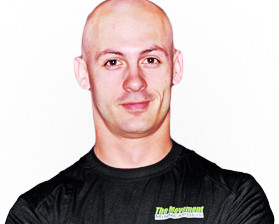
David Dellanave, known most often as ddn, is a lifter, coach, and owner of The Movement Minneapolis in the Twin Cities. He implements biofeedback in training; teaching his clients to truly understand what their bodies are telling them. He’s coached a number of athletes who compete at the international level in sports ranging from grip to rugby, and his general population clients readily demonstrate how easy it can be to make progress.

Latest Tweets

  • Just now
  • Follow me on Twitter

Important Pages

  • Coaching
  • Seminars
  • Disclaimer
  • Terms of Service
  • Privacy Policy

Comments

  • david on 3 Tips for Lifting While Sorting Through SI Joint Pain
  • David Brochin on 3 Tips for Lifting While Sorting Through SI Joint Pain
  • Ken on How to Pass the RKC Snatch Test
  • Bethuel Njoroge on Wild Game Hunting: Inhumane or The Most Humane?
  • Jennifer Matthews on 3 Tips for Lifting While Sorting Through SI Joint Pain

Copyright © 2026 · Generate Pro Theme on Genesis Framework · WordPress · Log in