
ddn

David Dellanave

  • Blog
  • Programs
  • Coaching
  • Seminars
  • Contact

by david Leave a Comment

Pain Is An Action Signal

Pain Is An Action Signal

As a fitness professional pain can easily be the most complex issue you’ll ever dive into. Mount Stupid is often evident, where you learn a little bit and you think you know everything and then you learn more and realize you know nothing.

But one thing that is incredibly clear about pain is that it’s an action signal.

I didn’t originate this idea – Lorimer Moseley one of the godfathers of pain science probably did.

Touch the stove, it hurts almost instantly, pull your hand away. Not fast enough to prevent a burn, but fast enough for you not to lose all the skin on your hand.

As kids we learn pretty quickly that pain is trying to tell us things, and we respond to it.

For some reason, fitness makes people dumb about pain. They think they NEED to experience pain, that it somehow correlates with results.

So they ignore pain, and what it’s trying to tell them.

They push through.

Then the pain gets louder, it moves around, and sometimes you go so far that you break the loop of sensation and action and now the pain is persistent even though it’s not at all obvious if there’s any action to take.

It can get really complicated, and chronic pain is one of the worst things you can have to live with. I don’t want to diminish that or give the impression that I’m saying it’s all so simple.

But I can tell you this from my experience helping people, pain usually means:

– You’re doing something too much.
– You’re not doing something enough.

I know that’s broad and vague, but it’s the single best heuristic to figure out what’s wrong.

If you’re driving down the freeway and everyone is waving at you and flashing their lights maybe they’re trying to tell you that you’re going the wrong way?

Never, ever, ignore pain signals – they’re trying to tell you something.

Filed Under: Blog

by david Leave a Comment

Stop Cueing, Start Fixing

Stop Cueing, Start Fixing

At a recent workshop someone asked me a good question that got me thinking about this topic and this is one of those things where the specific example is important, but not nearly as important as the bigger picture.

The question was, how do you cue someone to deadlift who is maybe afraid of bending at the hips due to a back issue.

And the answer, my friend, is not to cue them at all.

We have this obsession with cueing in physical training, as if it’s the only way to get the outcome we’re looking for. “Push your knees out, spread the floor, break the bar” and so on.

But as good and useful and double plus good that cues can be, ultimately you are still using a cognitive tool to address something that’s not very cognitive at all.

Instead of cueing, a better approach is to simply change the environment so that the only outcome you can get is the one you’re looking for.

In our example if someone is afraid to deadlift, or even more pertinent they literally CAN’T bend enough to deadlift, then we create an environment where they CAN deadift. Maybe instead of a bar we use a single kettlebell, and instead of coming from the floor we elevate it so that it’s just a few inches below their hand, and instead of breaking completely at the hips as in an ideal deadlift we bend a bit more at the knees.

Is this not a deadlift? It is by my definition.

Can we not lower the kettelbell over the weeks and months? Can we not switch from one bell to two, from two bells to a bar?

Of course we can.

No cueing involved. Just changing the environment so that you can only get one outcome. There’s also no effort involved, by the way. Cueing can take a lot of time, a lot of effort, and only be moderately effect. Making changes like this is literally an instant fix.

To change the frame a little, think about this in terms of nutrition. Getting ourselves or someone else to make nutrition changes when decisions and choices are involved can be really hard.

But if I cleaned out your cupboards of junk and provided you with a chef that would prepare anything you wanted fresh from primary ingredients, don’t you think it would be pretty easy to only eat really good food?

Of course it would be.

Quit training to brain-wrestle when you can just change the environment.

Filed Under: Blog, Ideas

by david Leave a Comment

An Observation From Globogym

An Observation From Globogym

Every time I go to the gym to lift, or on the occasions that I go to my other gym to use a treadmill for run workouts I notice something.

It seems like everyone is spending time lying on the floor or rubbing themselves against the wall doing various contortions in the name of stretching or foam rolling or soft tissue work or whatever.

And in talking to people it seems like everyone is complaining about an injury of some kind or another that is persistent and never seems to go away. Almost like what they’re doing is actually aggravating it.

Now I’m not saying this stuff doesn’t have any value because certainly in some cases it can be useful. I use two particular simple drills on the days I bench press that keep my right shoulder from getting cranky. But not for nothing I spend about 30 seconds total on this.

Maybe I am just an outlier, maybe I’m just lucky. Although it would seem that if I compare my gym clients and coaching clients to what I observe in other gyms maybe that isn’t the case.

But I don’t do any of this stuff, and I don’t have any persistent complaints. Besides the fact that it saves me a bunch of time, it’s nice that I don’t have all the complaints and pain issues!

I go to the gym, I get on the treadmill, I walk for a few steps and then I begin my run workout.

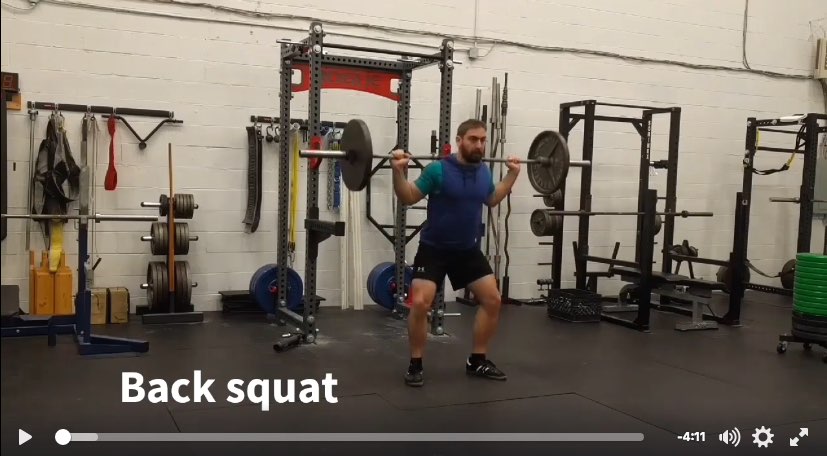
I go to the gym, I head to the squat rack, I start warming up with just the bar and I proceed from there.

So I don’t do what most people do before and after their workouts. But, I do perform my actual workout pretty differently from everyone else.

I use biofeedback to make sure the movements I’m doing are good for me.

I also don’t push past elements of excessive effort like extra tension, breathing pattern changes, or alignment shift.

I also generally keep my workouts relatively “easy” even when easy is sort of objectively hard.

I also use biofeedback to modify movements to make them work even better for me – to suit me perfectly.

Like I said, maybe this is is just an observation that doesn’t really mean anything and I’m an outlier.

Or maybe not. Maybe what I do differently makes a difference.

Filed Under: Blog, Ideas

  • « Previous Page
  • 1
  • …
  • 40
  • 41
  • 42
  • 43
  • 44
  • …
  • 82
  • Next Page »

Olive Oil

Upcoming Workshops

    No events to show

Search

David Dellanave

David Dellanave, known most often as ddn, is a lifter, coach, and owner of The Movement Minneapolis in the Twin Cities. He implements biofeedback in training; teaching his clients to truly understand what their bodies are telling them. He’s coached a number of athletes who compete at the international level in sports ranging from grip to rugby, and his general population clients readily demonstrate how easy it can be to make progress.

Latest Tweets

  • Just now
  • Follow me on Twitter

Important Pages

  • Coaching
  • Seminars
  • Disclaimer
  • Terms of Service
  • Privacy Policy

Comments

  • david on 3 Tips for Lifting While Sorting Through SI Joint Pain
  • David Brochin on 3 Tips for Lifting While Sorting Through SI Joint Pain
  • Ken on How to Pass the RKC Snatch Test
  • Bethuel Njoroge on Wild Game Hunting: Inhumane or The Most Humane?
  • Jennifer Matthews on 3 Tips for Lifting While Sorting Through SI Joint Pain

Copyright © 2026 · Generate Pro Theme on Genesis Framework · WordPress · Log in