
ddn

David Dellanave

  • Blog
  • Programs
  • Coaching
  • Seminars
  • Contact

by david Leave a Comment

What does a coach even do?

What does a coach even do?

Due in part to my wide and varied interests I’ve experienced a lot of coaching over the years. From piano lessons to indoor skydiving coaching I’ve seen a ton of different techniques and styles. My wife, Jen Sinkler, in her capacity has a fitness editor for a decade has quite possibly attended more fitness workshops than anyone else as well as having played rugby at an elite level thus had dozens of different coaches. We’ve been able to witness and experience a LOT of coaching.

What you may think of when you think of instruction or coaching is someone telling you how to do something new to you. And sure that might be part of it. But there’s much more that a good coach actually provides:

Safety: When you’re stepping outside your comfort zone to learn something new or go somewhere you’ve never gone before you want to know that you’re safe. Sometimes that’s literal safety like knowing you’re not going to get hurt with a new movement (or by slamming into the wall in the wind tunnel like I’m always afraid of) and sometimes it’s a more general sense of trust that you’re in good hands and it’s okay that it’s uncomfortable because you trust you’re safe.

Communication: Telling someone something is not the same as communicating. To communicate the other party has to receive the message, and that’s not always the case. A good coach however is a master communicator, always honing the message and tweaking it based on their judgement of how well you’re receiving it. You can see this when you watch a coach repeat the same cues without any change happening – they’re not adjusting the message to make sure communication is actually happening. Communication also means you understand the big picture and intention behind what you’re doing, not just the motions.

Instruction: This is, in my opinion, the least important piece as compared to the other two. If you feel like, and are, in a safe environment for experimentation you will eventually figure out whatever you need to although maybe not as quickly. And without communication the instruction is useless. But of course a piece of coaching is the actual methods of instruction. Some are demonstrably visibly better than others. I’ve worked with coaches who have made something click in one session that has taken others multiple sessions to not even break new ground on. A good coach experiments with different techniques and methods until they find the best practices that work with most people, but they also keep all the other ones in their back pocket in case the usual tricks don’t work.

These are the biggest and most important things that a good coach provides. There are others, but you’ll find the common thread among great coaches is that they fulfill these needs first and then everything else is just the cherry on top.

I was thinking about coaching for two reasons. One is that I was doing some flying in the vertical wind tunnel last night and experienced some of the best coaching I’ve ever had so it got my gears turning about what made it that much better. The other reason is that I’ve been thinking about reviving a group coaching group I did a few years ago that got rave reviews. We’d focus on a building strength with some good fundamental movements as well as some cool old time strongman stuff and you’d learn how to structure your training (and mindset!) to PR every time you train. If that’s something you’d be interested in, just shoot me a super quick message on my contact form.

Filed Under: Blog

by david Leave a Comment

But first let me check one more thing…

I sit down to write. The cursor blinks on the page.

Nothing is coming to me.

Better make sure nothing life-changing has been posted on Instagram.

Wait I was writing. Back to typing and deleting. Can’t think of anything.

Pretty sure there will be some breaking news on twitter that’s important…

Damn I should be creating something. Back to writing.

OK but nothing has come to me so I should probably check cryptocurrency prices.

Fine I’m back to writing but a whole 15 minutes has gone by and I haven’t been able to come up with something so maybe today isn’t the right day. Maybe I should sit this one out and come back when I feel fresh tomorrow?

The battle with distractions from you doing something hard but worthwhile is never ending. I’m sure Picasso didn’t have Facebook and Netflix but I’d wager he was no less distracted by fair maidens and breaking news telegraphs.

Maybe these distractions stop you from creating something that is trapped in your minds eye, or they pull you away from long term slow endeavours like building a strong body or aesthetic physique. Either way they’re stealing from you.

While there are no true “hacks”, it’s worth experimenting with different systems to interrupt an unproductive pattern. I have tons of friends who have had great luck with and swear by GTD, the Getting Things Done system. Others do something as simple as using the Pomodoro technique when they’re in dedicated work times. I don’t think it matters so much what systems you use, rather that you have something that causes you to examine and focus on your behavior if your automatic habits involve too much distraction.

At the end of the day it comes down to asking yourself the same question often and repeatedly: “Am I creating right now?”

Because in the end that’s what matters. What you create. No one has ever been remembered for what they consumed. Consumption can have a place in creation to be sure, I get some of my greatest inspirations from reading, but that type of consumption can be directly connected to creation.

It’s not clicking yes on “Are you still watching?”

Be patient. Sit with it. Sometimes it takes more than 5 minutes of investing your time before you see the payoff. Sometimes you have to start writing nonsense or drawing doodles or just showing up to the gym to move something before the inspiration really kicks in.

So do whatever you have to do to keep the focus, and go make what you’re capable of.

Filed Under: Blog

by david Leave a Comment

The Greatest Press Ever

Let me tell you a quick story, but a sad story, a story about a lifter.

When this lifter was young and new he started out doing bench presses just like any good lifter would do. Also like many others, these bench presses started to hurt his shoulders. But hurt shoulders were macho and cool, and it was a badge of honor not to be able to sleep on his side so he wore his pain proudly.

Luckily our lifter was called to adventure, entered the cave, and returned to the normal world with an evolution of his thinking. This evolution lead to him mostly avoiding bench presses for the next ten years rather than suffering through pain that wasn’t worth it. But without bench presses whatever would our lifter do for upper body development?
Fortunately for our lifter there is the other B-lift: the bent press.

If you are not familiar with the bent press then I am gleeful that it is I who gets to share this special lift with you for the first time.

The bent press is a one-arm lift that involves lifting a weight overhead with little to no pressing movement at all. In fact, calling it a press at all is a bit of a misnomer other than you are in fact putting the weight overhead without using a quick lift motion such as in a snatch or jerk. The actual movement is a bit more like a corkscrew under the weight.

Now what is particularly interesting about the bent press is how much weight can be hoisted with it. In fact, I can have you putting a bigger kettlebell overhead than you ever have before the very first day you learn it.

In lieu of getting too deep into the explanation in text, I think this video will be most helpful:

A major point on this movement not covered in the video: in my experience the best way to train this movement is very heavy, for very few reps, and very infrequently. In fact, the single best way I’ve found is to simply work up to a single max lift, preferably increasing to a new PR each time (using a loadable dumbbell versus kettlebell) and then waiting a week or two before tackling it again. Obviously if you are just learning the movement a few more reps will be helpful, but I do not believe that this is a movement that benefits from lots and lots of reps of lower weight.

Until someone shows me another lift where you can put almost 400lbs overhead with one hand, the bent press will always be king of the upper body lifts.

Filed Under: Blog

  • « Previous Page
  • 1
  • …
  • 31
  • 32
  • 33
  • 34
  • 35
  • …
  • 82
  • Next Page »

Olive Oil

Upcoming Workshops

    No events to show

Search

David Dellanave

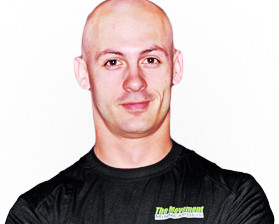
David Dellanave, known most often as ddn, is a lifter, coach, and owner of The Movement Minneapolis in the Twin Cities. He implements biofeedback in training; teaching his clients to truly understand what their bodies are telling them. He’s coached a number of athletes who compete at the international level in sports ranging from grip to rugby, and his general population clients readily demonstrate how easy it can be to make progress.

Latest Tweets

  • Just now
  • Follow me on Twitter

Important Pages

  • Coaching
  • Seminars
  • Disclaimer
  • Terms of Service
  • Privacy Policy

Comments

  • david on 3 Tips for Lifting While Sorting Through SI Joint Pain
  • David Brochin on 3 Tips for Lifting While Sorting Through SI Joint Pain
  • Ken on How to Pass the RKC Snatch Test
  • Bethuel Njoroge on Wild Game Hunting: Inhumane or The Most Humane?
  • Jennifer Matthews on 3 Tips for Lifting While Sorting Through SI Joint Pain

Copyright © 2026 · Generate Pro Theme on Genesis Framework · WordPress · Log in