ddn

David Dellanave

  • Blog
  • Programs
  • Coaching
  • Seminars
  • Contact

by david Leave a Comment

The Roomba Theory of Improvement

The Roomba Theory of Improvement

Yesterday I was recording an episode of SOFLETE’s Die Living Podcast. The guys at SOFLETE have been friends of mine for many years and it’s been a ton of fun watching them expand and do more and more awesome stuff, and it was a pleasure to be on the podcast.

At one point we got to talking about coaching and the contrast of a coach who gives six or eight things to work on at once versus those who work on one specific thing until it’s fixed before moving on to the next issue. You can probably guess who gets better results.

The same principle applies outside of coaching however, directly to self-driven improvement.

It makes me think of the Roomba, you know the little plastic manhole cover that bumbles around a room vacuuming it completely automatically?

Basically the way that a Roomba cleans is by going as far as it can in one direction before it bumps into a wall, then turns away and heads off in another direction until it can’t go anymore. Given a bit a time, it covers the whole room with this sort of random walk.

And this happens to be a great strategy for improvement in one, or many domains. Focus on one thing and go as far as you can with it before encountering immovable resistance. You’ll get much better at the thing you focus on, and because of the magic of human learning and adaptation you’ll also get a little bit better at peripheral things as well. Your whole sphere of capability expands a little tiny bit, and a lot in one direction. Then change direction and focus on something else for a little while until the same thing happens again.

With physical training this looks like block periodization where you might have a hypertrophy block that you take as far as you possibly can, before switching to a strength block for another period of time, before switching to a power block until you take that as far as it’ll go.

In general it might look like working on your physical training for a while, then focusing most of your time and attention on learning a musical instrument while putting training on maintenance mode, and then when you run out of steam there learning how to weld.

Focusing your efforts on one at a time will yield you much more than trying to juggle all three or more at once.

Filed Under: Blog

by david Leave a Comment

Why old school?

Why old school?

One question I hear a lot, some might even call it a criticism depending on the context, is why I lean so heavily on old school movements instead of what is popular and mainstream. It’s a good question and to understand the answer you have to go back and question some of the assumptions along the way.

The first assumption to examine is one that is very logical – that the most safe and effective exercises would be the ones that would stand the test of time and would be the ones we’d focus now. Another way of looking at it would be that the unsafe, ineffective, inefficient, or superfluous movements would get dropped along the way. The reality is that exercises get dropped, but not for any reason that has to do with how good they are for you to do at all. A classic example of this that most people are blissfully unaware of is that the original Olympic lifts are not the snatch and clean and jerk as they are performed today. In fact, those two lifts have only been contested since 1972. The original Olympic lifts are the one-hand snatch, the one-hand clean and jerk, and the two-hands clean and jerk.

These one-hand power lifts are absolutely fantastic for building total body coordination, power, balance, and strength. To get into specifically why is beyond the scope of this article, but I’d also argue that they’re in many ways safer than their bilateral counterparts. And you don’t have to use as much absolute load to get the same training effect. You know why they were dropped from competition? Because contests took too long with competitors having to do both hands. Once they were dropped from contests, they naturally fell out popularity with everyone else. Plus, there’s an argument to be made that in the 60’s when bodybuilding really started to become popular these exercises that required tremendous strength but not necessarily muscular size fell out of favor.

In the same way a whole host of movements and exercises that are great for the individual have fallen out popular usage for reasons wholly unrelated to how good they are on an individual level.

The next assumption is that there is a best or perfect way to do exercises and this has been codified and disseminated and you can compare what you’re doing to the textbook and know if it’s correct or not. The result is that if you do a conventional deadlift it’s very likely that every asshole in the gym has an opinion on whether or not you’re doing it correctly and is likely to share it.

On the other hand, if you do a Jefferson deadlift they will assume you are doing a deadlift so far from correctly that they won’t bother to try to correct you.

But one of the things that I hope people take away from what I teach is that there really is no empirically correct way to do any movement. Every individual is different and your movement reflects that. Sure there can be generalities and common things that are usually true, but not always. With old school movements there is often more of a context for variability because no one really has an idea of what ideal should look like. Everyone I’ve ever seen bent press does it a little differently and none of them are wrong. This also ties into movements that have been bastardized over the years to make them easier to judge in competition, and those rules bleed into the form recommendations whether they’re good or not.

Listen, there are plenty of movements that have been forgotten for good reason. I’m not planning to bring back chest expanders any time soon. But if an “old school” movement is safe, effective, and it imposes stresses in the right places to achieve the training effect I’m looking for you can bet I’m going to use it and teach it.

Filed Under: Blog

by david Leave a Comment

A Freezer Filling Skill

On Wednesday morning I got up very excited to share this video with you. And then I checked the news.

Suffice it to say that I didn’t think it was appropriate to send out this video on the day of a mass shooting.

But here’s an uncomfortable truth: there’s a mass shooting almost every single day in the United States. 154 in 165 days. And that’s using the narrowest definition. It doesn’t even include the shooting on the same day in San Francisco where four people including the shooter died.

So either there’s never a good day to talk about how to use a rifle properly for hunting or precision sport shooting, or any day is as good as any other.

I sit at a weird place when it comes to guns and regulations. I’ve jumped through the BATF’s hoops and waited through almost year-long waiting periods to have a firearm or a part that meets some narrow and ridiculous set of criteria. I’ve also walked into a gun store and walked out with a handgun I could easily conceal when a convicted sex offender used a house showing to steal my social security number and I had no idea if he was coming back.

And yet in general I think it’s way too easy. I think we need a major re-thinking of gun policy in this country. In fact, if someone could wave a wand and round up all the guns in the country I’d hand mine over. That’s not going to happen, so we need to think really, really hard about making it aggressively difficult to buy firearms, unbelievably costly when you use one in a crime, and impossible to keep when you’ve already committed a crime that demonstrates you can’t be trusted.

That said, as long as firearms exist as a tool to be used for hunting and sport shooting I think it’s well worth learning how to use them properly. This video focuses on the skills you need to shoot a precision long rifle out to long distances, well past the typical 100 yards. If you’re a hunter it’s critical to be a competent shooter so that you can make a clean and ethical kill the first time every time. Even if you’re not a hunter, precision rifle shooting is a lot of fun. In the western U.S. there are great events that combine hiking, navigation, adventure, and difficult shooting challenges into endurance precision shooting events. And even if you’re just plinking steel, long distance shooting involves combining basic fundamentals of shooting with deep knowledge of conditions and even some math.

It’s hard to convey the satisfaction you get when everything comes together and you pull the trigger to hear the distinct “ping” of steel a couple seconds – or longer – later. Or, when you take an animal you’ve been hunting for hours or days and it drops in on the spot and you know you’ve filled your freezer for the next several months with the most natural free range meat there is.

In this Human Skill video I take my good friend Marshal through the basic setup to hit a target 300 yards – imagine three football fields – away. You’ll have to watch the video to see if he gets a hit on his first try.

While I’ve only scratched the tip of the iceberg for precision shooting – like anything worth doing you could do it for a lifetime and not learn everything – these are the fundamentals you need to be able to shoot accurately at any distance.

I hope you enjoy this video, and I sincerely hope that some day soon we have more sensible gun laws in this country.

Filed Under: Blog

  • « Previous Page
  • 1
  • …
  • 30
  • 31
  • 32
  • 33
  • 34
  • …
  • 82
  • Next Page »

Olive Oil

Upcoming Workshops

    No events to show

Search

David Dellanave

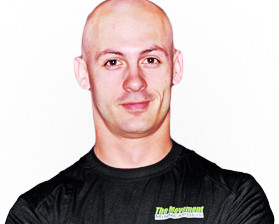
David Dellanave, known most often as ddn, is a lifter, coach, and owner of The Movement Minneapolis in the Twin Cities. He implements biofeedback in training; teaching his clients to truly understand what their bodies are telling them. He’s coached a number of athletes who compete at the international level in sports ranging from grip to rugby, and his general population clients readily demonstrate how easy it can be to make progress.

Latest Tweets

  • Just now
  • Follow me on Twitter

Important Pages

  • Coaching
  • Seminars
  • Disclaimer
  • Terms of Service
  • Privacy Policy

Comments

  • david on 3 Tips for Lifting While Sorting Through SI Joint Pain
  • David Brochin on 3 Tips for Lifting While Sorting Through SI Joint Pain
  • Ken on How to Pass the RKC Snatch Test
  • Bethuel Njoroge on Wild Game Hunting: Inhumane or The Most Humane?
  • Jennifer Matthews on 3 Tips for Lifting While Sorting Through SI Joint Pain

Copyright © 2026 · Generate Pro Theme on Genesis Framework · WordPress · Log in